George Crawford Kerr and Cyrus Hussey Families in 1800’s


Introduction

In this blog, I am sharing some of my family history along with a description of the techniques and resources I used in the search and some tips for your own research. I am also sharing this story for my family and others who may be interested in this Kerr family and their journey from Erie County, New York, to Bates County, Missouri.

My mom (now deceased) did family genealogy research for over 30 years (pre-internet). She had gathered copies of multiple records about the Kerr and Hussey families, including census records, George C. Kerr’s handwritten Will, Phebe Addis’ handwritten divorce papers, and land records for Cyrus and Diadama Hussey and for Ben and Phebe Addis in Bates County, Missouri. She also had a note about the location of George C. Kerr’s burial in Lake County, Illinois. Her records included a collection family pictures with information on the back, which has been very beneficial in creating the family tree.

I continued the family research with the assistance of the internet, including verification of records in my mom’s collection (verified!!!) and location of additional sources. For my research, I used Ancestry.com as my primary genealogy platform, Newspapers.com, Google Chrome, Find-a-Grave, and email communications with the Ela Township, Lake County, IL, historical society. I am sharing a overview of the our Kerr family story, a sample of the records, and pictures I took recently of the area where our Kerr and Hussey family lived in the 1850’s/1860’s (Cuba Township, Lake County, IL).

Note: I typically use Ancestry.com for my searches, but there are other very good genealogy platforms available. I have provided an overview of some of these genealogy platforms and resources on the “Resources” page, which you can access from the blog menu. If you have another preferred genealogy platform or other resource you would like to share with the readers, please send the information in “Comment”.

The Alexander Kerr Family of New York

George Crawford Kerr and Phebe Ann Morris were my maternal 3rd great-grandparents. He was the son of Alexander Kerr and wife Elizabeth1 who were both born in Ireland2. Alexander and Elizabeth had 11 sons and one daughter: Robert, William, John, Ruth, Alexander (Jr), Peter, Elijah, James, George Crawford, David, Patterson, and Thomas Jefferson1. Note: Some family trees include Elizabeth. Census records show that this Elizabeth was the aunt of Michael Kerr of Washington County, NY. The records show that Michael was the son of Robert Kerr who also lived in Washington County. One record that suggests that Elizabeth was not the daughter of Alexander was the 1800 U.S. Census. The census did not include names, but it recorded one daughter (under the age of 10); no daughters > 10 years of age. Alexander had one daughter, Ruth, born about 1795.

The Alexander Kerr family settled in Deerpark, Orange County, New York, by the late 1700’s. How long they lived in Deerpark is unknown, but records show Alexander in Deerpark from at least 1799 to 1812. These records include the New York State Census (1800), tax assessments of real and personal estates3, and a record of Aliens in 18124. The record of Aliens was collected by the U.S. Marshals during the the time of the War of 1812 on behalf of the U.S. State Department. This information was self-reported. At the time of collection, Alexander (Sr.) and his oldest son Robert lived in Deerpark, Orange County (not to be confused with Deer Park, Suffolk County). His second son, William, lived in Newburgh, Orange County, New York. Alexander (Sr) was a farmer. Robert and William were merchants. This document supports the possibility that Alexander and Elizabeth’s two oldest sons were born before they arrived in the United States, even though census records give the place of birth as New York4.

Migration to Erie County, New York

After the American Revolution, indigenous people whose home land included what is now western New York were forced to relinquish claim to their land. In 1800, the Holland Land Company purchased this land from the state and laid claim to the title to land that now forms eight counties on the western side of New York, including Erie County. The Holland Land Company then sold lots, spurring white settlement in the region. The first white settlers came to the region in the early 1800’s5. The town of Eden, originally called “Hills Corners”, was established in 18126. The nearby town of Collins was formed in 18215. Small communities, known as hamlets, which had stores, businesses and post offices to support the community and those passing through the area. One such hamlet, which lied in the northwest corner of the the boundaries of Collins Township (now North Collins Township), was initially called Rose Corner, named after Chester Rose, who ran a store at the location. John and Alexander (Jr) Kerr purchased the store and this small community became known as Kerr’s Corner. Other Kerr brothers established businesses, including a hotel, and Isiah and then John served as the post master. Kerr’s Corner was located at the corner of Main and Brant streets9. Through the years, the population grew as well as the businesses and services to support the community. With this growth, Collins township was divided. In 1852, the northern section was established as North Collins township. The town of Shirley was established, which encompassed Kerr’s Corner. The town was renamed North Collins in 185310.

The following map shows the town of North Collins, Erie County, New York11, which is located in the extreme northwest corner of North Collins township, formerly part of the Collins township.
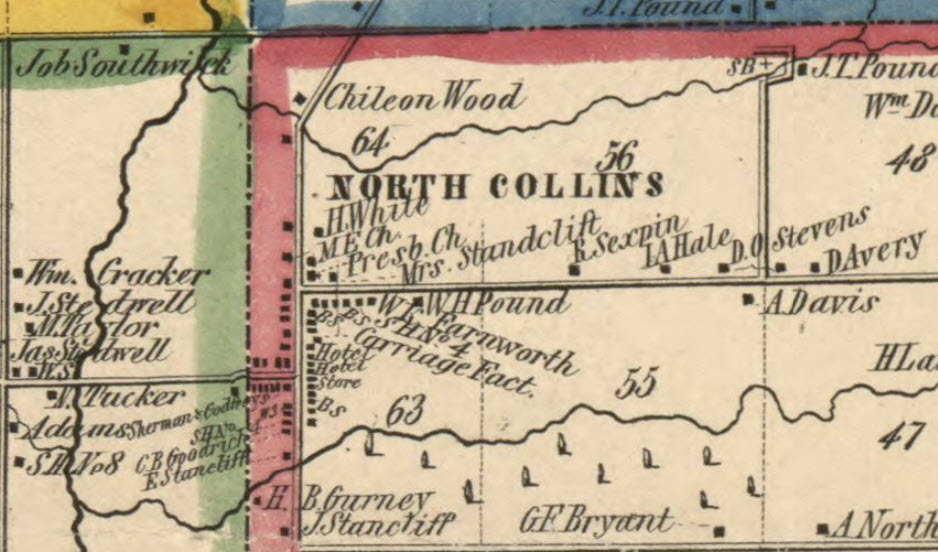
Map of North Collins, Erie County, New York, 1854

Most of Alexander and Elizabeth’s children lived in the Erie County, New York, at some point in their adulthood. I found records showing all of their children, except William, Peter, and possibly Robert, living in the southern portion of Erie County, known as the “south towns”. William and Peter’s dates of death suggest that they likely died before their siblings relocated to Erie County. It is unclear whether Robert lived in Erie County. There are records for a Robert Kerr living in Erie County, but I do not know if this is our Robert Kerr8,9,12,13.

John and Alexander (Jr.) ran a mercantile store and their brother, Patterson, ran a hotel at Kerr’s Corner. In 1827, Alexander (Jr) was elected a Justice of the Peace for Eden. David owned an Inn in Collins in 1938. He lived in nearby Brandt. Elijah and John served as postmasters. James, Alexander (Jr), John, and Patterson all owned land in Collins township in the 1850’s8,9,12,13. The 1854 map of Erie County11 shows land owned by T. J. (Thomas Jefferson) Kerr in Collins Township. Census records show George Crawford Kerr and family lived in Hamburg, Erie County in 1830. The family moved to Collins, near the other brothers by 1840. Ruth, daughter of Alexander & Elizabeth, and her husband, Hiram A. Hinman lived in Collins in 1850.

Some of the Kerr siblings remained in Erie County throughout their adulthood, but some moved to other locations, primarily near Erie County. In 1840, Ruth Kerr Hinman and family lived in Pennsylvania, but they returned to Collins by 1850 George Crawford Kerr was living in nearby Cattaraugus County in 1850, where other brothers moved and/or owned land, as well as the Morris family, Phebe’s parents and siblings. But George C. Kerr moved to Lake County, Illinois, by 1855, living near his wife, Phebe, Morris Kerr’s, brother. George and Phebe’s daughter, Diadama; her husband, Cyrus Hussey; and their daughter, Ann “Lib”, moved to Lake County, IL, with her parents15.

George Kerr and Phebe Ann Kerr (nee Morris)

George Crawford Kerr was born in New York about 1806, likely in Orange County. His wife, Phebe Ann Morris, was born about 1809 in Vermont. Phebe was the daughter of John Morris and Ruth Moon. According to census records, Phebe’s father was born in New Jersey and her mother was born in New York. The Morris family lived in Bennington, Vermont, in 1810. They were living in Hartford, Washington County, New York, in 1820, and by 1830, they had moved to Cattaraugus County, New York, where John Morris lived at the time of his death. After John’s death, Phebe’s mother, Ruth, moved to Iowa with her son Cyrus and family. She died in Iowa City, Wright County, Iowa, in 1870. Her body was returned to Cattaraugus County, New York, for burial with her husband16.

George and Phebe had one daughter. Diadama Cordelia Melvina Kerr. The 1840 U.S. Census also showed a male age 10-14 living in the home of George Kerr, in Erie County, New York. According to the 1855 Illinois Census, an adult male age 20-29 was living with the family. The identity of this male person is unknown; some researchers have speculated that this young male was George and Phebe’s son.

Diadama Kerr married Cyrus Cleveland Hussey, a descendant of Christopher Hussey, Tristram Coffin, and Edward Starbuck, who were considered to be three of the nine Founding Fathers of Nantucket, Massachusetts, in the 1600’s. It is important to note that Nantucket was the home of indigenous people, prior to and during the early years of European settlement. I will blog more about Cyrus Hussey’s ancestry in a future blog.

Kerr and Hussey Family Move to Lake County, Illinois

Sometime between the collection of the 1850 U.S. Census (New York) and the 1855 Illinois State Census, George and Phebe Kerr, and Diadama, Cyrus, and Diadama’s daughter, Anna Elizabeth “Lib”, moved from Cattaraugus County, New York, to Nunda Township, McHenry County, Illinois. In the 1860 U.S. Census, George and Phebe Kerr, and the Hussey family were living in Cuba Township, Lake County, Illinois. Diadama and Cyrus had two more children, Catherine Estella “Stelle” and John Ellis, born while the family was living in Illinois.

TIP: If you are using a genealogy platform, you may have difficulty finding persons in the database using the search feature. One reason this may happen is the transcription of records, such as census records, may be done electronically. The older documents are difficult to read and/or the names may have not be recorded accurately. I use various techniques to search for the records, including searching for persons in the census images by using a known family member as a starting point. Close relatives frequently lived in the same vicinity. I also search other member’s family trees that include the person or persons I am looking for because they may have located the records. Sometimes I use other genealogy platforms and/or a Google search.

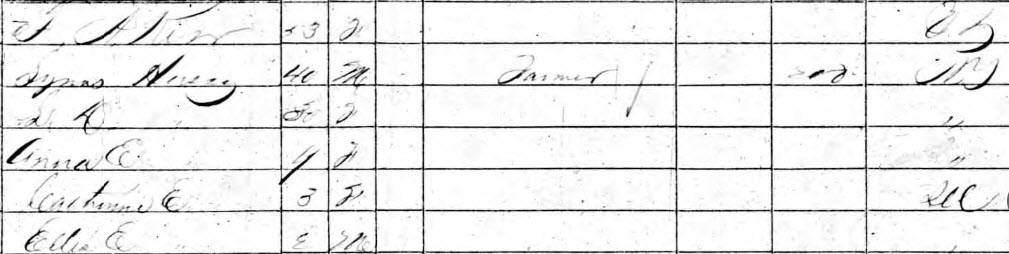
Initially, I was unable to locate my Hussey family in the 1860 census using the Ancestry. com search feature. I did locate the Kerr family, after several attempts. The challenge was that George C. and Phebe Ann’s initials were recorded as “J. C.” and “F. A.” rather than “G. C.” and “P. A.” I then searched for the Cyrus Hussey family. The traditional search did not produce a result, so I reviewed the image. I found Cyrus and Diadama living at the next dwelling recorded in the census. The entry is difficult to read, and the transcription of the image was recorded as “Lynas Hersey” and “L. D. Hersey”. I included the image below to show how it looked. Note: the record did include the three children, but I did not include them in this image.

Cyrus and Diadama (D A) Hussey
1860 U.S. Census, Cuba Township, Lake County, Illinois
(accessed Ancestry.com)

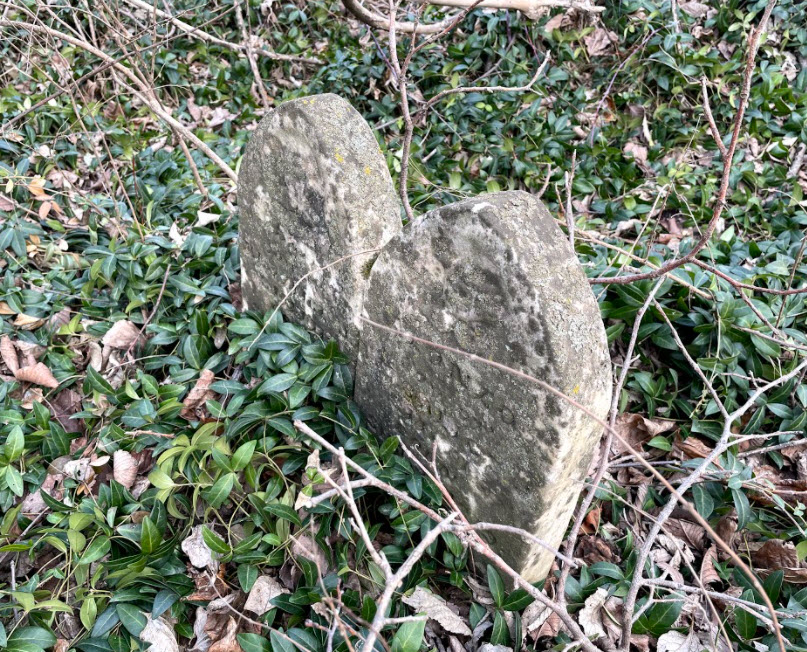
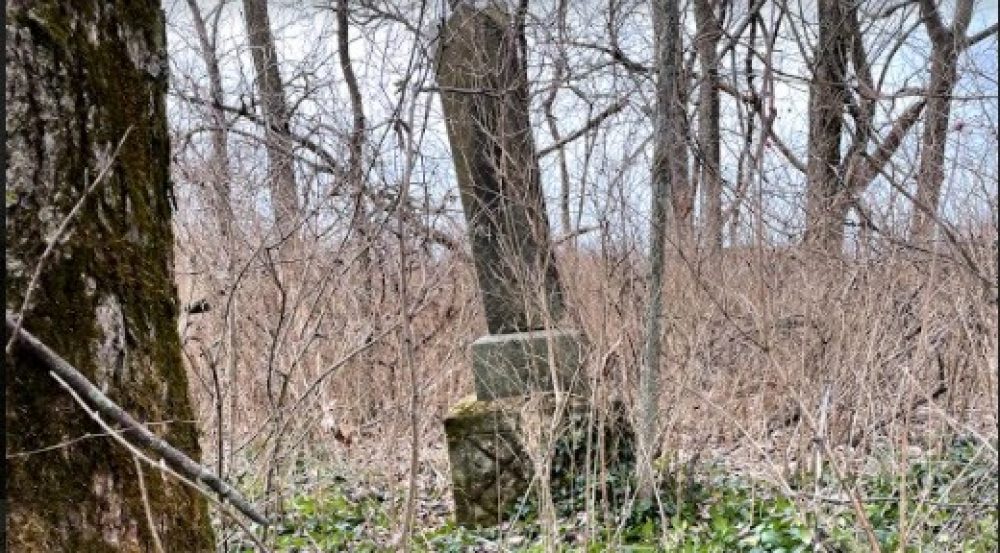
George Kerr died on the 9th of Jul 1863 in Lake County, Illinois. He was buried in the Bennett Cemetery (Ela Township) located in the mile section east of the Kerr property (Cuba Township). The abandoned Bennett Cemetery is on private property and requires permission to go onto the property16,17. I have driven by the property, but was not able to determine the exact location of the cemetery. It has been reported that the few remaining stones are lying down as shown in the picture of George Kerr’s gravestone below. The president of the Ela Township (Lake County, IL) Historical Society provided the picture of George’s headstone. TIP: Local historical societies and genealogical societies can be helpful resources when searching for family genealogy.
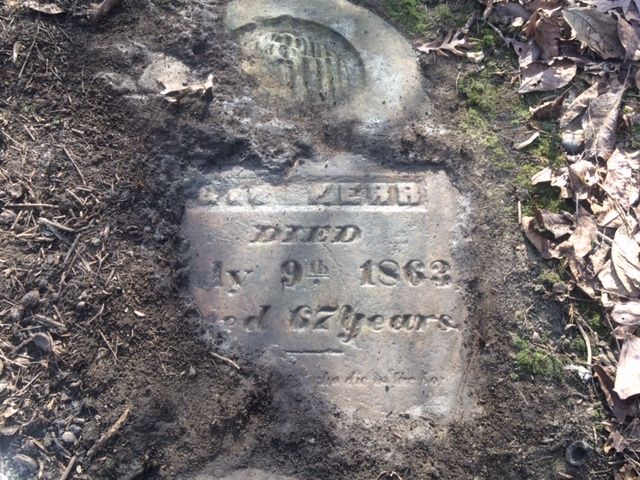
George C. Kerr Headstone; Bennett Cemetery, Lake County, IL
(Photo provided by President of Ela Township Historical Society; published with permission)

Kerr and Hussey Families Move to Bates County, Missouri

After George’s death, Phebe married Benjamin Addis on 24 Dec 1864 in Chicago, IL. Benjamin was a veteran of the Union Army in the Civil War. By 1868, the Phebe and Ben Addis and Cyrus and Diadama Hussey owned land in the Charlotte and Elk Hart Townships, Bates County, Missouri.

Cyrus Hussey died in January of 1886 in Bates County, Missouri. Diadama died in the following year, 1867. The 1891 Map shows their property was located in the southern part of Elk Hart Township, near their youngest daughter, Anna and her husband John Hedger, who lived in the neighboring Charlotte Township. Diadama and Cyrus’ son, John Ellis Hussey, was also living in Charlotte Township. The map below shows where the Cyrus Hussey property was located in relationship to the Howell Cemetery, where the family is buried.

Cyrus Hussey Property (blue arrow)
Adam Howe aka Howell Cemetery (yellow arrow)
Elk Hart Township, Bates County, Missouri, Map of 1895

Diadama’s mother, Phebe, died sometime after 1891.The following map shows the Addis Estate, where Phebe Morris Kerr Addis lived. This map validates the family story that Granny Addis, as called by the family, owned property north of the Christian Church.

The Christian Church on this map is no longer there, but the Methodist (M.E. Church) continues to have services to this date. The Grange Hall (building) was moved to a property about one mile south of Virginia many years ago. There were two general stores located across the road from each other. Stores were operated at those locations until the store on the east side of the road closed for business in the 1960’s and the store on the west side of the road closed for business about 25 years later. Today, a retail pecan business operates on the east side of the road. The post office closed years ago.
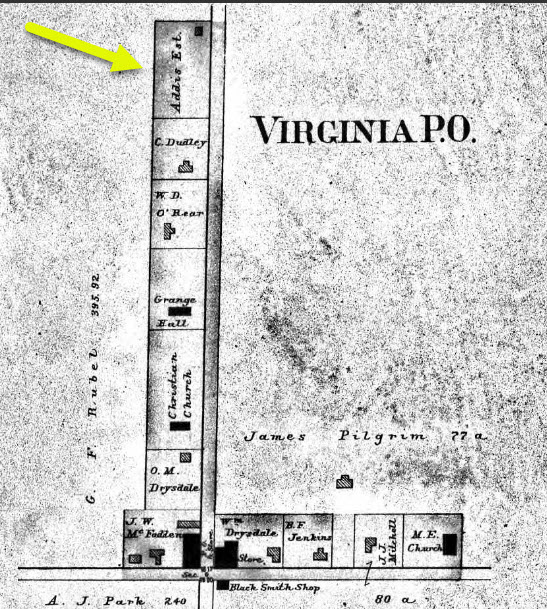
Phebe Addis Estate
Virginia, Charlotte Township, Bates County, Missouri, Map of 1895

Researching Where My Ancestors Lived in 1850s and 1860s

In addition to the census records, I used several resources to determine where my Kerr and Hussey families lived. One document I reviewed was George C. Kerr’s Will, which I accessed as a public document in Ancestry.com. The Will gives a specific description of the property. According to George Kerr’s Will, his property was located in Section thirteen in Township forty-three Range nine East of the third principle meradion [sic].


Property Description, Will of George C. Kerr, 03 Aug 1858

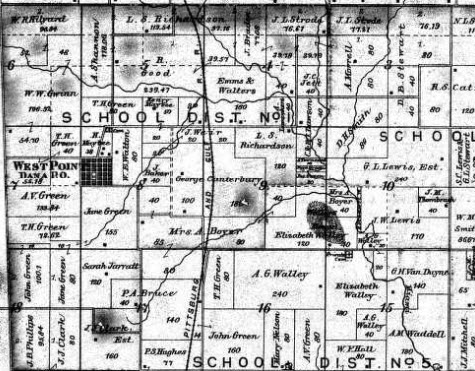
Next, I searched for a plat map of Lake County, Illinois, that showed the sections, townships and Range to compare to the written description of property in the Will. I searched Google Chrome for a “Plat Map of Lake County, Illinois”. I located the 1861 Map of Landowners in Lake County, Illinois18,19. The map is maintained by the Library of Congress (Hale, G. (1861) Map of Lake County, Illinois. St. Louis: L. Gast Bro. & Co. Lith. [Map] Retrieved from the Library of Congress, https://www.loc.gov/item/2013593105/). TIP: Be sure to check copyright and how to cite source. This citation was provided by the Library of Congress.

I have included an excerpt of the map showing the portion of Cuba Township (section 13 and Ela Township (section 18) below. The map shows Geo. C. Kerr property in 1861, highlighted in purple and marked with a yellow arrow, and the location of George C. Kerr’s burial in the now abandoned Bennett cemetery, marked with a yellow arrow.

1861 Map of George C. Kerr Property in Cuba Township and Burial in Ela Township, Lake County, IL

Tip: Some plat maps are available through genealogy platforms, such as Ancestry.com, but I find an Internet search usually results in available maps. You may also find maps for purchase, which may include additional information.

What Cuba Township, Lake County, Illinois Looks Like Today

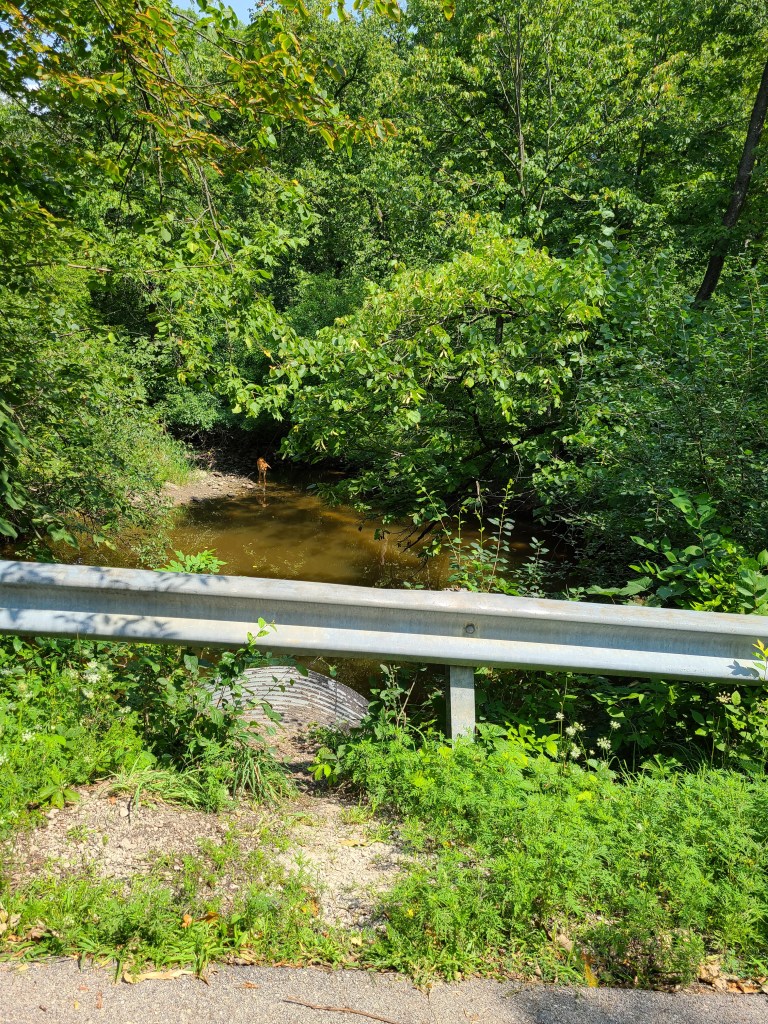
I traveled to Lake County, Illinois, in August of 2021, and visited the area where the Kerr and Hussey families lived. I have included two pictures I took that show how the area looks now. There are houses nestled in these wooded areas, but I did not take pictures of those properties to respect privacy. The creek seen in the photo below is the creek that ran through the George Crawford Kerr property.
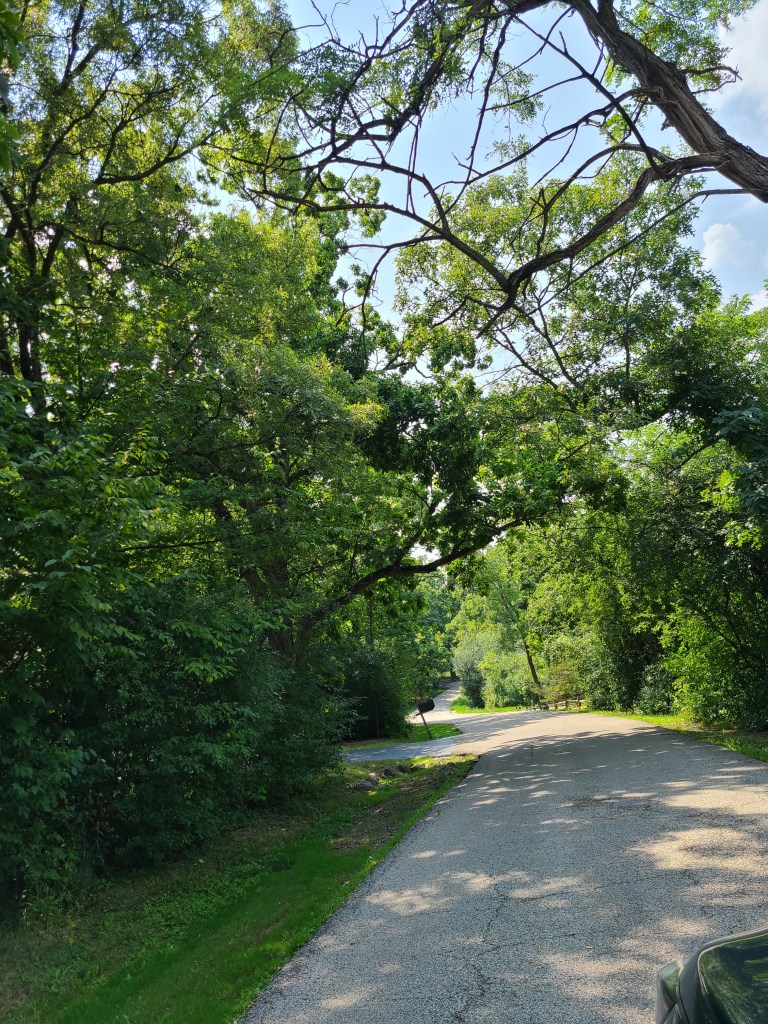
Cuba Township, Lake County, Illinois 2021
Photographed by Dr. B Genealogy
Cuba Township, Lake County, Illinois, 2021
Creek Running thru the former Geo. Kerr Property
Photographed by Dr B Genealogy

Wrap Up

I hope you enjoyed reading about the my Kerr family and the Diadama and Cyrus Hussey family. I will blog more about Cyrus Hussey’s ancestors in a future blog, taking the family tree back to the early years in the colonies and Nantucket.

Soures:.
1The Kerr Clan of New Jersey: Beginning with Walter Ker of Freehold and including Other Related Lines, Vol. 1., compiled by William Clinton Armstrong, The Sawver Publishing Co.: Morrison, IL, 1931. Note: The book is available through several sources, including (1) Hathi Trust Digital Library, FamilySearch.org, Ancestry.com or purchase online.
2U.S. Census Records, accessed through Ancestry.com; available in FamilySearch.org or other genealogy platforms.
3New York, Tax Assessment Rolls of Real and Personal Estates, 1799-1804; accessed thru Ancestry.com.
4New York, Tax Assessment Rolls of Real and Personal Estates, 1799-1804
5Wikipedia: Erie County, New York, retrieved 04 Feb 2022
6Wikipedia: Eden (Erie County), New York, retrieved 04 Feb 2022
7Wikipedia: Collins (Erie County), New York, retrieved 04 Feb 2022
8Our County and Its People: A Descriptive Work on Erie County, New York, Vol. 1, Edited by Truman C. White, The Boston Historical Publishers: Boston, 1898; This work is available online viewing and purchase through multiple sources, including the Cornell University Library Internet Archive
9Reminiscent History of North Collins (Erie County, New York) by Emily Stewart, 1914; digitalized copy owned by the Western New York Library Resources Council, Western New York Genealogical Society, 2011. This document was a hand written history of North Collins, New York, from 1809 to about 1889. The book includes the sons of Alexander Kerr, who were living in the area: John, Elijah, Patterson, and David.
10Wikipedia: North Collins (Erie County), New York, retrieved 04 Feb 2022
11Map of Erie County, New York: from actual surveys, Philada:Robert Pearsall Smith, Publisher ; Buffalo : John Angell, Publisher, 1854. Retrieved 06 Feb 2022.
12Buffalo Commercial Advertiser (Buffalo, New York) 21 Jul 1838, p. 4: David Kerr; Newspapers.com
13Buffalo Commercial Advertiser (Buffalo, New York) 22 Oct 1860, p. 4: T. J. Kerr; Newspapers.com
14Illinois State Census, 1855, Nunda Township, McHenry County, Illinois, accessed through Ancestry.com; available in FamilySearch.org or other genealogy platforms.
15Find-a-Grave ID 37869647 Ruth Moon Morris
16Find-a-Grave ID 68585055 George C. Kerr
17Ela Township, Lake County, Illinois, Historical Society, e-mail communication with society president
18Plat Book of Bates County, Missouri, 1895: Elk Hart Township. The State Historical Society of Missouri. Retrieved 06 Feb 2022.
19Plat Book of Bates County, Missouri, 1895: Virginia P.O., Burdette. The State Historical Society of Missouri. Retrieved 06 Feb 2022.

Are we related to Daniel Boone? Using Family Stories for Genealogical Research

Has your family passed down stories about relatives? Does your family claim relations to someone notable? Family stories may just be the clue you need to make a family connection. One of the stories passed down through my mom’s family was that we are related to the frontiersman Daniel Boone. In this post I will describe how I found the answer to the question about our connection to Daniel Boone, while searching for my third great grandfather’s relatives. For those who may not be familiar with Daniel Boone, I will start with a brief description of his notoriety in American history.

Daniel Boone (1734-1820) has been recognized as an American pioneer and frontiersman. Boone was credited for exploration beyond the borders of the first thirteen colonies, leading to the settlement of what is now Kentucky. In the later years of his life, he lived on the west side of the Mississippi River in what is now known as St. Charles County, Missouri, which was part of the Spanish Louisiana at the time1. A television series (1964-1970) about the legendary frontiersman2.

My great-great grandfather Stark told my mom that the Stark’s were related to Daniel Boone; however, he did not know how. My mom was an avid genealogist. She was on a quest to determine how we were related to Daniel Boone (long before the days of Internet). My mom researched Daniel Boone and his family, but she was unable to find the link between the Stark family and the Boone family. One of the challenges my mom faced was that no one had determined who my third great grandfather, Pleasant Stark’s, parents were. Prior to the 1850 Census, only the head of household was named in the Census. By the time the names of all members of the household were listed in the Census, Pleasant was married, no longer living with his parents. The only other record my mom located was his marriage record. The record did include Pleasant’s stepfather’s name; however, the name is illegible3. Some family researchers questioned if Pleasant’s surname was Stark or if that was his stepfather’s name.

As more DNA connections are made in Ancestry.com, I periodically revisit the research of my family lines. About a year ago, I focused my attention on my Stark family line. I reviewed “hints” for my fourth great grandfather and I used the “DNA match” feature in the research. I searched for DNA connections with the surname “Stark” in their family trees. Based on the findings, I determined it was very plausible that Rueben Zachary Stark was Pleasant Stark’s father. I added Rueben to my family tree and began building out the Stark family line, reviewing the documentation supporting the family members.

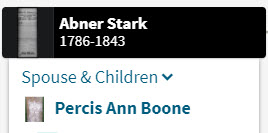
During the additional research of the Stark family, I had an “ah-ha” moment that I might have found the connection to the Boone family. I found that Rueben Stark had a brother named Abner, who was married to Persis/Percis Boone.

Abner Stark and wife Percis Ann Boone,
Ancestry family tree

Then I began the search to determine if and/or how Persis might be related to Daniel Boone. I started with a search of Persis’ direct lineage in Ancestry.com. I did not find Daniel Boone in her direct ancestry. At this point, I turned to Wikipedia to see if I could find the names of Daniel Boone’s parents. I found that his parent’s names were Squire Boone Sr. and Sarah Morgan. Next, I traced Squire Sr.’s lineage, searching for a common ancestor with Persis Boone. I found that Persis’ great grandfather George Boone IV was a brother to Squire Boone Sr., making Persis’ grandfather Josiah Boone and and Daniel Morgan Boone first cousins

The question is answered. The Stark family is not related to Daniel Boone, but Daniel’s cousin did marry into the Stark family. The question about Pleasant’s parents has not be resolved definitively, but my DNA connections in Ancestry.com strongly suggest that Pleasant’s father was Reuben Z. Stark and that Stark was Pleasant’s actual surname. Sadly, my mom passed before we had any answers to these questions.

Research Hints:

  • Family stories can be used for clues in family research
  • Non genealogical sources such as Wikipedia or googling names can be a source of information
  • Search family beyond your direct lineage for additional clues

References:
1Wikipedia, Daniel Boone, accessed 17 Mar 2021.
2Wikipedia, Daniel Boone TV Series, accessed 17 Mar 2021.
3Ancestry, accessed 17 Mar 2021

Using Census Records for Family Research

This week I focused my blog on using census records as tools for searching for family. This blog will discuss sources of census records and tips for using the census records in your search.


INTRODUCTION TO CENSUS RECORDS

Census records can be valuable tools in the search for family and for connecting family relationships. However, census records have limitations and challenges. In this blog, I will look at types of census collections in the United States, ways to access census records, and tips for searching for people in the census records. Nearly all census records in the United States from the beginning of decennial census collection to 1940 are digitalized and may be accessed through free and subscription services. I included some of these sources in this blog, but the list is not all inclusive. The Resources page available on the Menu includes some free and subscription sources for accessing census records.

HISTORY OF U.S. CENSUS RECORDS

I will start with an abbreviated history of the U.S. Census. The British colonies did take some censuses. After the American Revolution, the forefathers set forth in the U.S. Constitution that a census would be collected every 10 years. The first decennial census was collected in 1790. Until 1850, the census only gave the name of the head of the household; other residents of the household were recorded by demographics such as gender and age (by bracket). Beginning in 1850, the census records included all persons residing in the household. From 1790 through 1870, census collection was the responsibility of the U.S. Marshalls who hired assistants from the local communities to document the census. Unlike today, census data was not collected from each individual household; rather, the information was collected from persons who had knowledge of residents in the community1. This form of collection accounts for some of the variations in names, spelling of names, ages, etc., which may create challenges in validating persons from one census record compared to another census record.

It is important to be aware that most of the records for the 1890 U.S. Decennial Census were destroyed in a fire in 1921. A list of the available census records is provided by the U.S. Census Bureau2.

For the protection of privacy, U.S. Census records cannot be released for 72 years3. Therefore, the most recent U.S. Census record made public is the 1940 census. The 1950 census is scheduled to be released for public viewing in 2022.

CENSUS OF SLAVES AND FREE PERSONS OF COLOR

Prior to the 1850 U.S. Census, a record of slaves was not included in the dicennial census collection. The 1850 and the 1860 U.S. Census collections included Slave Schedules. These records usually only gave the name of the slave owner, with a list of their slaves identified just by their race (black or mulatto), age, and gender4. The document African Americans and the Federal Census, 1790-1930, published by the National Archives and Records Administration, provides an overview of how slaves and free persons of color (non-white) were enumerated in the decennial census records5.

CENSUS OF AMERICAN INDIANS

Prior to the 1900 U.S. Census, few American Indians are included in the federal census records. Information about the Census collection for American Indians is available on the United States Census Bureau history webpages6. The Bureau for Indian Affairs (BIA) also collected census records. Information about these census records is available on the National Archives, Native American Heritage website7.

Additional information is available in the section on State Census Records in this blog.

CENSUS OF NATIVE ALASKANS

The United States purchased the territory of Alaska in 1867. The U.S. included accessible villages in the 1880 and 1890 census collections, but these records have not survived. The Year 1900 is the first decennial census with records available8. A history of the census collection in Alaska is available from the U.S. Census Bureau information about remote areas of Alaska being the first in the U.S. decennial collection9.

The Bureau of Indians Affairs (BIA) also collected periodic Census Records. The National Archives site provides a guide to BIA Records10. The Sealaska Heritage Institute Alaska Archives provides information about BIA Alaska Census records 1913-197211.

Additional information is available in the section on State Census Records.

1890 VETERANS CENSUS

In 1890, the U.S. Pension Office collected information on Union veterans and widows of Union veterans for use in the pension process. It is reported that the records for the states of Alabama through Kansas as well as one half of Kentucky were destroyed. Fragments of some of these states were preserved12.

1865 Kansas Census, Miami County, Osage Township

STATE CENSUS RECORDS

In addition to U.S. Census records, states conducted their own census collections. These collections were not conducted consistently, but the records can offer additional information, particularly following the movement of persons to different locations. The U.S. Census Bureau provides a comprehensive list of states and the years census data was collected13.

WAYS TO LOCATE CENSUS RECORDS

I included a list of links to resources for accessing census records. This list does not consist of all sources, but serves as a guide to locating census records. Some sources have free access and other sources require a paid subscription or fee to access the census records. In choosing the source, I recommend considering what other resources and services the organization/service may provide in choosing the best tool/s for you. For additional sources, you can contact your local library and/or conduct a search of the internet. If you are interested in searching records at an on ground location, such as public libraries, be sure to check the webpages or contact the organization before making a visit. The facility may be closed or have restrictions for in person visits because of current COVID-19 conditions and/or restrictions.

Family Search – online free, requires set up of an account
Family History Library – Salt Lake City, Utah; at the time of this post the website states the site is closed for in person research due to COVID-19; website includes links to other family search resources
Midwest Genealogy Center – free on ground site, part of the Mid-Continent Public Library, Independence, Missouri (Kansas City area); check for in person access
Public libraries – check with the library to determine record access and in person research access
Ancestry.com – online; paid subscription
GenealogyBank – online; paid subscription
MyHeritage – online; paid subscription
National Archives – free online resources; the online website site does not provide access to online census records, but includes information about regional sites and research resources. At the time of this post, in person access to the National Archives are suspended due to COVID-19.

TIPS FOR USING CENSUS RECORDS

Digital searches for persons in census records offer ease of use and quick access to records; however, searches can present challenges. Census records were handwritten for many years. Transcription for search purposes have errors due to difficulty in reading the handwriting. Another issue in searching census records was the persons name recorded in the census. An issue I have experienced is that the names documented may have been middle names, nicknames, different spellings of names, and sometimes incorrect names. Additionally it is not uncommon for ages or place of birth to be inconsistent. I have included some suggestions for researching census records based on my personal experience.

NAMES: Names can be a challenge in the search of census records. Names may be recorded as nicknames, a middle name, name variations, initials, misspelled names, etc. For example, I found the name of “Willis Porter” given in his father’s obituary. This is a child that I had not found in any other record. The obituary gave Willis’ place of residence in a different state than his father and known siblings. I used this information along with his estimated age (range) based on the age of his siblings. It took multiple searches, but I found a person named Willie Porter in the appropriate age range. He was living with a family in the state given in the obituary. The relationship to the head of household was “nephew”. At this point, I researched the the head of household and his wife. I found that Willis’ name was William K. Porter. He was living with his maternal aunt and her family.

TIP: If you cannot find the person, search for variations and spellings of the name, and other family members, such as aunts, uncles, grandparents, siblings, or children.

Phebe Kerr and Cyrus, Diadama, Anna, Catherine, and Ellis Hussey, 1860 Census, Lake Co. IL

NEIGHBORS: While electronic searches of census records are the quickest and easiest ways to find people or families, sometimes it is necessary to read through the census records. Until recent years, censuses were handwritten by the census collector. Census records were transcribed to for electronic searches. Some records are transcribed through computer algorithms. Transcription errors occur. For example, my search for Cyrus and Diadama Hussey in the 1860 census did not return any results. I knew from other records that Cyrus and Diadama were supposedly living in the same county as her parents, George and Phebe Kerr, in Lake County, Illinois. So I searched for George and Phebe. I found a record transcribed as J C Kerr and F A Kerr. I determined that this was the Kerr family for whom I was searching. Directly below F A Kerr, I found Cyrus and Diadama Hussey with their children. The names were difficult to read and had been transcribed as the name Hershey.

TIP: If you cannot find the person in a census record, search for other family members, particularly if you know they lived in the same community. Once you find the relative, read through the census document to see if you can find the person/family. I start with the same page as well as the pages before and after the family member. Years ago, families frequently lived close to other family members – parents, siblings, children. I have success using this technique in multiple searches.

LOCATION BOUNDARY/NAME CHANGES: When searching for locations, it can be helpful to research the history of the name of the state, county or town, or the change in borders. For example, West Virginia was originally part of Virginia. During the American Civil War, Virginia succeeded from the Union, becoming a Confederate state. The residents of the western section of the state sought separation from Virginia and, in turn, West Virginia was admitted to the Union. Therefore, persons living in what is now West Virginia were living in Virginia prior to the Civil War, which may create some confusion about place of birth in the Census records pre-Civil War and post-Civil War. Another example is Miami County, Kansas. The county was formed under the name of Lykins, but was later changed to Miami. Electronic census searches may note these changes. Another similar situation I found was a family whose place of birth was given as Germany in some Census records and France in other Census records; France was given as the place of birth in their obituaries. The family immigrated to the U.S. in 1866. The family’s original home was Alsace in eastern France. Research revealed that this region in France became part of Germany in 1871 and returned to France after World War I; thus, explaining the confusion as to place of birth for persons living in or immigrating from this region.

TIP: Do your homework. If something does not seem to make sense, I recommend taking the time to look at the history of the location to determine if there is an explanation for the variations in the stated locations in the census records. Wikipedia is a good starting place and includes references for further research and validation as deemed necessary.

BLOG WRAP UP

This blog post is intended to help in family research. I plan to continue posting about census records, particularly specialized census records, in future blogs. I hope you find something helpful or at least interesting, and continue to follow my blogs. Take care!

REFERENCES

https://www.archives.gov/research/native-americans/census1United States Census Bureau, History, accessed 17 Mar 2021
2United States Census Bureau, History, 1890 U.S. Census Availability, accessed 17 Mar 2021
3United States Census Bureau, History, 72-Year Rule, accessed 17 Mar 2021
4United States Census Bureau, History, 1850 Census (Slaves), accessed 17 Mar 2021
5African Americans and the Federal Census, 1790-1930, National Archives and Records Administration, accessed 19 Mar 2021
6United States Census Bureau, History, American Indians, accessed 17 Mar 2021
7National Archives, Native American History, accessed 19 2021
8Rootsweb, Census Records for Alaska, accessed 17 Mar 2021
9United States Census Bureau, Remote Locations, accessed 17 Mar 2021
10National Archives, Guide to BIA Records, accessed 19 Mar 2021
11Sealaska Heritage Institute Alaska, BIA Alaska Census Records, 1913-1970, accessed 19 Mar 2021
12United States Census Bureau, History, 1890 Veterans Census, accessed 17 Mar 2021
13United States Census Bureau, History, State Census, accessed 17 Mar 2021


Welcome

Welcome to my inaugural blog. So why this blog? I greatly enjoy sharing my genealogy finds with my daughter, my family, and my friends, particularly when the finds come from unexpected places. For some time, my daughter has encouraged me to document my genealogy journey. The time is now. My plan is to blog weekly, sharing my family research experiences, providing search tips and techniques, and sharing resources to help others in their research journey. Watch for the tagline Research Techniques in future blogs.

My mom was an avid researcher. She is deceased, but she left her legacy – a passion for genealogy and boxes of genealogy records, family stories, family pictures, and information provided by other family researchers. One of the most important gifts my mom left for my family research is the oral and written family stories. I’ve found “nuggets” in these stories that helped me validate family relationships. In my blog, I will share how some of these stories became “ah-ha” moments in my research. Watch for the tagline Family Stories in future blogs.

Headstone of Infant Twins in Abandoned Cemetery, 2021

Find A GraveTM biographies, family relationships, and burial locations are valuable sources in genealogy research. I am a contributor to Find A Grave. I focus on adding to biographies and to family relationship links. I also add gravestone pictures for cemeteries in my region. Recently, I engaged my daughter in helping me search and photograph an overgrown, abandoned cemetery. My daughter also videoed our experience. The headstone picture included in this post is one of the grave markers we found. In a future blog, I will share our experience, including the video, as well as other experiences in cemetery memorial research. Watch for the tagline Cemeteries.

About seven years ago, I began family research for a friend who was adopted. She was born in the Alaska territory, but grew up in the mid-west. She had limited information about her birth parents, but her adoptive parents had been told that one of the grandparents was Native Alaskan. Through the use of DNA, genealogy records, and some unexpected sources, I have created her family tree. This journey has been challenging, interesting, and rewarding. In my blog, I will share how we researched her family and the amazing outcomes of this search. Watch for the tagline Alaska.

I enrich my genealogy research with local and regional history. The history helps add to my understanding of the experiences of people who lived in the area and the reasons they may have moved to or moved out of the area. In my blog, I will share some history of where my family lived and how it helped in the search for my family. Watch for the tagline History. I also plan to add links to history resources in the Resource page available on the navigation bar.

I hope that you find something helpful and/or interesting in my weekly blogs. You can follow me on Facebook and on Instagram, and/or send me your comments or questions through the Contact page (menu on navigation bar).