This week I focused my blog on using census records as tools for searching for family. This blog will discuss sources of census records and tips for using the census records in your search.
INTRODUCTION TO CENSUS RECORDS
Census records can be valuable tools in the search for family and for connecting family relationships. However, census records have limitations and challenges. In this blog, I will look at types of census collections in the United States, ways to access census records, and tips for searching for people in the census records. Nearly all census records in the United States from the beginning of decennial census collection to 1940 are digitalized and may be accessed through free and subscription services. I included some of these sources in this blog, but the list is not all inclusive. The Resources page available on the Menu includes some free and subscription sources for accessing census records.
HISTORY OF U.S. CENSUS RECORDS
I will start with an abbreviated history of the U.S. Census. The British colonies did take some censuses. After the American Revolution, the forefathers set forth in the U.S. Constitution that a census would be collected every 10 years. The first decennial census was collected in 1790. Until 1850, the census only gave the name of the head of the household; other residents of the household were recorded by demographics such as gender and age (by bracket). Beginning in 1850, the census records included all persons residing in the household. From 1790 through 1870, census collection was the responsibility of the U.S. Marshalls who hired assistants from the local communities to document the census. Unlike today, census data was not collected from each individual household; rather, the information was collected from persons who had knowledge of residents in the community1. This form of collection accounts for some of the variations in names, spelling of names, ages, etc., which may create challenges in validating persons from one census record compared to another census record.
It is important to be aware that most of the records for the 1890 U.S. Decennial Census were destroyed in a fire in 1921. A list of the available census records is provided by the U.S. Census Bureau2.
For the protection of privacy, U.S. Census records cannot be released for 72 years3. Therefore, the most recent U.S. Census record made public is the 1940 census. The 1950 census is scheduled to be released for public viewing in 2022.
CENSUS OF SLAVES AND FREE PERSONS OF COLOR
Prior to the 1850 U.S. Census, a record of slaves was not included in the dicennial census collection. The 1850 and the 1860 U.S. Census collections included Slave Schedules. These records usually only gave the name of the slave owner, with a list of their slaves identified just by their race (black or mulatto), age, and gender4. The document African Americans and the Federal Census, 1790-1930, published by the National Archives and Records Administration, provides an overview of how slaves and free persons of color (non-white) were enumerated in the decennial census records5.
CENSUS OF AMERICAN INDIANS
Prior to the 1900 U.S. Census, few American Indians are included in the federal census records. Information about the Census collection for American Indians is available on the United States Census Bureau history webpages6. The Bureau for Indian Affairs (BIA) also collected census records. Information about these census records is available on the National Archives, Native American Heritage website7.
Additional information is available in the section on State Census Records in this blog.
CENSUS OF NATIVE ALASKANS
The United States purchased the territory of Alaska in 1867. The U.S. included accessible villages in the 1880 and 1890 census collections, but these records have not survived. The Year 1900 is the first decennial census with records available8. A history of the census collection in Alaska is available from the U.S. Census Bureau information about remote areas of Alaska being the first in the U.S. decennial collection9.
The Bureau of Indians Affairs (BIA) also collected periodic Census Records. The National Archives site provides a guide to BIA Records10. The Sealaska Heritage Institute Alaska Archives provides information about BIA Alaska Census records 1913-197211.
Additional information is available in the section on State Census Records.
1890 VETERANS CENSUS
In 1890, the U.S. Pension Office collected information on Union veterans and widows of Union veterans for use in the pension process. It is reported that the records for the states of Alabama through Kansas as well as one half of Kentucky were destroyed. Fragments of some of these states were preserved12.

STATE CENSUS RECORDS
In addition to U.S. Census records, states conducted their own census collections. These collections were not conducted consistently, but the records can offer additional information, particularly following the movement of persons to different locations. The U.S. Census Bureau provides a comprehensive list of states and the years census data was collected13.
WAYS TO LOCATE CENSUS RECORDS
I included a list of links to resources for accessing census records. This list does not consist of all sources, but serves as a guide to locating census records. Some sources have free access and other sources require a paid subscription or fee to access the census records. In choosing the source, I recommend considering what other resources and services the organization/service may provide in choosing the best tool/s for you. For additional sources, you can contact your local library and/or conduct a search of the internet. If you are interested in searching records at an on ground location, such as public libraries, be sure to check the webpages or contact the organization before making a visit. The facility may be closed or have restrictions for in person visits because of current COVID-19 conditions and/or restrictions.
Family Search – online free, requires set up of an account
Family History Library – Salt Lake City, Utah; at the time of this post the website states the site is closed for in person research due to COVID-19; website includes links to other family search resources
Midwest Genealogy Center – free on ground site, part of the Mid-Continent Public Library, Independence, Missouri (Kansas City area); check for in person access
Public libraries – check with the library to determine record access and in person research access
Ancestry.com – online; paid subscription
GenealogyBank – online; paid subscription
MyHeritage – online; paid subscription
National Archives – free online resources; the online website site does not provide access to online census records, but includes information about regional sites and research resources. At the time of this post, in person access to the National Archives are suspended due to COVID-19.
TIPS FOR USING CENSUS RECORDS
Digital searches for persons in census records offer ease of use and quick access to records; however, searches can present challenges. Census records were handwritten for many years. Transcription for search purposes have errors due to difficulty in reading the handwriting. Another issue in searching census records was the persons name recorded in the census. An issue I have experienced is that the names documented may have been middle names, nicknames, different spellings of names, and sometimes incorrect names. Additionally it is not uncommon for ages or place of birth to be inconsistent. I have included some suggestions for researching census records based on my personal experience.
NAMES: Names can be a challenge in the search of census records. Names may be recorded as nicknames, a middle name, name variations, initials, misspelled names, etc. For example, I found the name of “Willis Porter” given in his father’s obituary. This is a child that I had not found in any other record. The obituary gave Willis’ place of residence in a different state than his father and known siblings. I used this information along with his estimated age (range) based on the age of his siblings. It took multiple searches, but I found a person named Willie Porter in the appropriate age range. He was living with a family in the state given in the obituary. The relationship to the head of household was “nephew”. At this point, I researched the the head of household and his wife. I found that Willis’ name was William K. Porter. He was living with his maternal aunt and her family.
TIP: If you cannot find the person, search for variations and spellings of the name, and other family members, such as aunts, uncles, grandparents, siblings, or children.
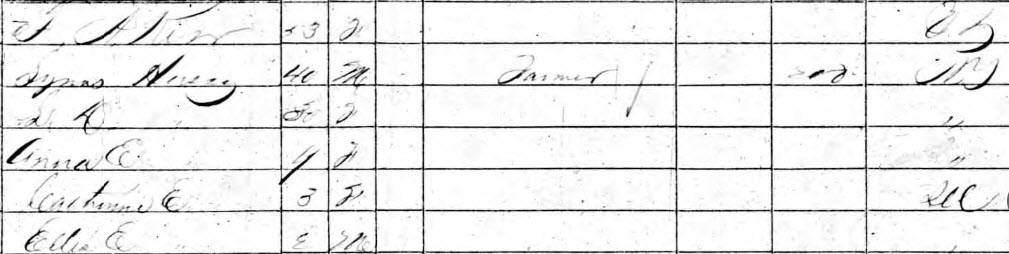
NEIGHBORS: While electronic searches of census records are the quickest and easiest ways to find people or families, sometimes it is necessary to read through the census records. Until recent years, censuses were handwritten by the census collector. Census records were transcribed to for electronic searches. Some records are transcribed through computer algorithms. Transcription errors occur. For example, my search for Cyrus and Diadama Hussey in the 1860 census did not return any results. I knew from other records that Cyrus and Diadama were supposedly living in the same county as her parents, George and Phebe Kerr, in Lake County, Illinois. So I searched for George and Phebe. I found a record transcribed as J C Kerr and F A Kerr. I determined that this was the Kerr family for whom I was searching. Directly below F A Kerr, I found Cyrus and Diadama Hussey with their children. The names were difficult to read and had been transcribed as the name Hershey.
TIP: If you cannot find the person in a census record, search for other family members, particularly if you know they lived in the same community. Once you find the relative, read through the census document to see if you can find the person/family. I start with the same page as well as the pages before and after the family member. Years ago, families frequently lived close to other family members – parents, siblings, children. I have success using this technique in multiple searches.
LOCATION BOUNDARY/NAME CHANGES: When searching for locations, it can be helpful to research the history of the name of the state, county or town, or the change in borders. For example, West Virginia was originally part of Virginia. During the American Civil War, Virginia succeeded from the Union, becoming a Confederate state. The residents of the western section of the state sought separation from Virginia and, in turn, West Virginia was admitted to the Union. Therefore, persons living in what is now West Virginia were living in Virginia prior to the Civil War, which may create some confusion about place of birth in the Census records pre-Civil War and post-Civil War. Another example is Miami County, Kansas. The county was formed under the name of Lykins, but was later changed to Miami. Electronic census searches may note these changes. Another similar situation I found was a family whose place of birth was given as Germany in some Census records and France in other Census records; France was given as the place of birth in their obituaries. The family immigrated to the U.S. in 1866. The family’s original home was Alsace in eastern France. Research revealed that this region in France became part of Germany in 1871 and returned to France after World War I; thus, explaining the confusion as to place of birth for persons living in or immigrating from this region.
TIP: Do your homework. If something does not seem to make sense, I recommend taking the time to look at the history of the location to determine if there is an explanation for the variations in the stated locations in the census records. Wikipedia is a good starting place and includes references for further research and validation as deemed necessary.
BLOG WRAP UP
This blog post is intended to help in family research. I plan to continue posting about census records, particularly specialized census records, in future blogs. I hope you find something helpful or at least interesting, and continue to follow my blogs. Take care!
REFERENCES
https://www.archives.gov/research/native-americans/census1United States Census Bureau, History, accessed 17 Mar 2021
2United States Census Bureau, History, 1890 U.S. Census Availability, accessed 17 Mar 2021
3United States Census Bureau, History, 72-Year Rule, accessed 17 Mar 2021
4United States Census Bureau, History, 1850 Census (Slaves), accessed 17 Mar 2021
5African Americans and the Federal Census, 1790-1930, National Archives and Records Administration, accessed 19 Mar 2021
6United States Census Bureau, History, American Indians, accessed 17 Mar 2021
7National Archives, Native American History, accessed 19 2021
8Rootsweb, Census Records for Alaska, accessed 17 Mar 2021
9United States Census Bureau, Remote Locations, accessed 17 Mar 2021
10National Archives, Guide to BIA Records, accessed 19 Mar 2021
11Sealaska Heritage Institute Alaska, BIA Alaska Census Records, 1913-1970, accessed 19 Mar 2021
12United States Census Bureau, History, 1890 Veterans Census, accessed 17 Mar 2021
13United States Census Bureau, History, State Census, accessed 17 Mar 2021
 Dr. B Genealogy